
BIBLIOGRAPHY
An ongoing reading list with quotes, understandings, and thoughts.
Non-exhaustive, alphabetized by title, and engaging.
Animal Farm
George Orwell
"And a moment later, out from the door of the farmhouse came a long file of pigs, all walking on their hind legs" (98).
I did not read this in high school, I read Lord of the Flies (William Golding), but I think I would have felt it then as well as now. I find parallels to modern culture, when resources and labour and space are all finite, but corporations buy and sell like an oligarchy.
We do not live in a farm, and life to come is unwritten. How will you act?

Art and Climate Change
Maja and Reuben Fowkes
"Even the 'protoplasm that streams within each cell of our bodies', as pioneering ecologist Rachel Carson observed... bears the 'chemical structure impressed upon all living matter when the first simple creatures were brought forth from the ancient sea'" (90).
A fairly comprehensive survey of artists responding to the development of the ongoing climate crises compiled through conversations and chapters with numerous makers worldwide. I found more on plants moving with weather here, which reminds me of Macbeth (Shakespeare). Obrist made a review on the back, I appreciate that. I aim for such levels of productivity, simply because I'm running out of time.
Can you find a research paper in the artwork you see? I promise, when you look at art through this perspective, everything glows with potential.
Art as Therapy
Alain de Botton & John Armstrong
"We are not transparent to ourselves. We have intuitions, suspicions, hunches, vague musings and strangely mixed emotions, all of which resist simple definition. We have moods, but we don't really know them" (39).
Rather West-centric, but I really liked the ways art is broken up into approaches: it is a pool providing remembering, hope, sorrow, rebalancing, self-understanding, growth, and appreciation. It drums question of purpose & value like love, patience, resilience, reason sensuality, curiosity, perspective, inspiration etc. Readings can vary from technical, political, historical, shock-value, and therapeutic, even guiding reform. However, I still struggle to wrap my mind around the segment revolving around money. Another read when I am not tired is required.
Can an artist's practice be therapeutic and rigorous? What then does it become when it is made to be bought and sold?
Artistic Ecologies
ed. Pablo Martinez, Emily Pethick, What, How, & for Whom / WHW
"[In an except from Cecilia Vicuna's, Sabor a Mi, artist book:] The struggle must be waged in cultural fronts. To consoli date the revolution we must create a cultural movement and change people's realities... a change in social consci ousness... invent your task, do it" (10)!
Old ideas recounted as imaginaries, institutions, individuals, and complex art objects scrutinize beliefs and think in new ways, old ways, or pave the ways for something yet to be conceived. The spirit of the book illuminates that we have reconfigured before, we can do it again, step by step, in sharing skills, knowledge, power etc. This text shows me that doors don't close, every choice just leads to new choices, the real and magical are to be valued, and we all have something to share if consenting. You are a case study, hold tradition, or special knowledge, account for something - are scientist or historian, connector, space for rest, provide both the ordinary and extra-ordinary. I think this book helps push my understandings of my practice, or what is an art practice, every time I read. I wonder about the places I stand, my body, mind, and the enmeshment. Sometimes I feel I have nothing to offer, or I worry I am hoarding knowledge. However, I want to understand, question, and participate, with care and reason, and pass that along. Perhaps that is why I made this bibliography. We cannot wait for someone to teach us what we do not know, this may happen incidentally, but for that to happen incidentally we would have to place ourselves in the position to be learners, acters, players. Every field intersects. Together, we rise or fall.
I can get anxious when learning, when there isn't a neat path or answer, the discomfort is just engrained. However, pushing through unsettling feelings has led me to beautiful, fun, insightful places. How can I shake this incubus off me, change this or that to the thrilling this and that and that and that... etc.?


Art Monsters: Unruly Bodies in Feminist Art
Lauren Elkin
"I think they know but I want to write them a letter and say it is not going to last... life doesn't last, art doesn't last, it doesn't matter" (223).
An exploration of feminist artists defining their own visual language, material, and questions focused on female, queer, sick, and/or racialized bodies.
An ex-friend once asked me, "Why do you paint yourself ugly?" I still think about this, what she meant, and what purpose that view has on my work, how I see my work, and how I move forward with my work.

Art & Physics
Leonard Shlain
"As language, math, and logic take hold, they drive magic out of the child's being... The price we pay in order to think as adults is the loss of our former naive... most of us never look back, because the road is overgrown with thicket and we abandon the hope of return." (141).
Rather West-centric, but very intriguing conversations along the line of whether the "chicken" or the "egg" came first. I was captured by the description of Einstein's time/space understanding with an elongating world surrounding myself, shrinking me, folding me. The image of Magritte's The glass house (1939) haunts me.
What have we not-yet learned that I am tapping into, if anything at all?

Autotheory as Feminist Practice in Art, Writing, and Criticsm
Lauren Fournier
"One of the most notable ways in which the autotheoretical turn is tied to histories of feminist practice is the simple fact that feminist artists continue to face the charge of narcissism when they incorporate themselves in direct ways into their work (and feminists themselves are not immune from launching such critiques" (43).
A book on understanding autotheory in the arts as a genre of Feminist action, especially against dominating cultural sentiments. It is, perhaps ironically, heavy on theory itself. To my understanding, it surveys a history of artists working in the umbrella; I found joy diving into semiotics, citation use as relation / love / passion, the incorporation of the mundane, varied approaches and receptions to autotheory, and its inherent liminalities. Autotheory is Feminist. Autotheory is human.
How do you tell your own story? What is theoretical about you?

Before I was a Critic I was a Human Being
Amy Fung
"The past lives on in the present" (19).
A sentiment echoed again and again. Fung presents some fundamental teachings on Canada one should get in high school. The Canadian culture is, inevitably, tied to its roots in colonialism, assimilationism, and a gap between Indigenous peoples and those who have settled on or immigrated to this land. The author's lived and learned vignettes encouraged me to question nostalgias. I get the sense everything overlaps always and nothing truly can be pulled from another facet of reality, we must continue to study the spectrum.
How do you unlearn? This doesn't meaning giving up, no matter how deep you are in. Start asking questions of yourself, and then search for the answers. The years will pass anyways, so choose to build!


BITCH: On the Female of the Species
Lucy Cooke
"There is little doubt that the first creatures reproduced by cloning... The earliest reproductive organism had to be able to lay eggs and that's a female" (26).
An untangling of misconceptions attributed to those ascribed the female sex, claiming the gender of woman, or otherwise associated with femininity. Those who study any discipline in the Western world by conventionally Western means will be misled again and again when putting preconceptions ahead of findings instead of letting findings speak for themselves.
What can curiosity without learned expectation look like?

Braiding Sweetgrass
Robin Wall Kimmerer
"The lichen, in a single body, unites two great pathways of life: the so-called grazing food chain based on the building up of beings, and the detrital food chain based on taking them apart... wrapped in each other's arms, the warp and weft of the same blanket so closely woven that it's impossible to discern the giving and the taking... these ancients carry teachings in the way that they live... people have not returned the favour" (274-5).
Historical relationships and teachings that the land offers provided by the perspective of the knowledgable Potawatomi ancestor-and-scientist Kimmerer. Poetic in a Steinien way, upon reflection, the awe in ecosystems' mundane livelihoods. I found it most notable the title relationship innumerable Indigenous groups have with sweetgrass; controlled gathering makes room for generational understanding of human-plant relationships and enhances growth of the rest of the structure. Win-wins are possible, have been possible, have been known, have been overlooked.
Cultures across the world have fostered reciprocal relationships with the land from time immemorial, where has that flourished and where has that broken down - rather, where can we sit down, listen, and learn?


Climate, Psychology, and Change
Steffi Bednarek
"James Hillman (1995) says: 'By not recognizing that the soul is also in the world, therapy cannot do its job anymore. The buildings are sick, the institutions are sick, the banking system's sick, the schools, the streets-the sickness is out there'" (6).
Bednarek works with diverse and multiperspectival health professionals who admit current therapy cannot respond to a hegemony of individualism amidst ongoing world-changing events. WIERD culture (Western, Educated, Industrialized, Rich, and Democratic) resist the potential evolution of mental health when it resists acknowledging the people around the person, the life and soul of environments, mutual benefit through active engagement, the real impacts of (and of addressing) colonialism & its interrelated issues, and the collective trauma of current life. With this, new psychotherapies can emerge with hope to offer plural and practical approaches in our complex system.
I will tell myself I am excited to open up each day, with others, even if the words feel cumbersome. How do you develop a safe space for development?

Dispersals
Jessica J. Lee
"Wakame is now a species with a 'global nonnative range.' Read that again: it is everywhere, but it is still out of place.'" (79).
Reflections between the author's interactions, research, and use of plants with connection to phases of her life. People have always been on the move, and plants have followed. Plants have been taken, gifted, employed, and tailored for thousands of years. There are a variety of relationships we have to them.
I cannot help but consider ecosystems that are becoming burdened, while others find a symbiosis of sorts. In which cases of travelling species are acceptable, reciprocal, fair etc., compared to playing god?

Extraordinary Insects
Anne Sverdrup-Thygeson
"It's too late to worry when a species is on the brink of extinction. Species cease to function in an ecosystem long before the last individual dies out" (178).
Insects are quirky when you look closer. The book showcases the many purposes insects hold to each other and their respective ecosystems as equally as to human health, industry, and pleasure. Memories were conjured of childhood road trips as the truck would accrue greasy yellow stains, the shattered stained glass that were dragonfly wings, and nondescript antenna (or legs?). Now, not so much. Sverdrup-Thygeson points to a German study in 2017 that presents a 75% decrease in insect biomass, finding the same trends in 2019 even with different methods. I feel cold.
We owe honour to insects for their support of our species and others. Our knee-jerk reaction may be fear or disgust, but hold it, hold it back a little. What are you missing when you see a bug? Get a tissue or leave it be.

Field Notes From A Catastrophe
Elizabeth Kolbert
"An evergreen was marked with a plaque that read 'Farthest North Spruce Tree on the Alaska Pipeline: Do Not Cut.' Predictably, someone had taken a knife to it. A deep gouge around the trunk was bound with duct tape. 'I think it will die,' Romanovsky told me" (18).
Highlights models of changing relationships: animals and plants are migrating due to temperature, specialist species struggle - often falling wayside to those with more plasticity in their genealogy. Things understood as curses or variance in past persist. We know better in our case, but governments, companies, and families act under the realm of business as usual. An eye opener to whole groups of people most vulnerable as rising waters and flagrant weather destroy coastal homes while melting permafrost threatens traditional livelihoods.
You cannot sit in a comfortable void forever. How much evidence to we need to know if we want to pass down something or, rather, place greater value in being the last man standing?

Funny Weather
Olivia Laing
"A useful analogy for what [Eve Kosofsky Sedgewick] calls 'reparative reading' is to be fundamentally more invested in finding nourishment than identifying poison... being driven to find or invent something new and sustaining out of inimical environments" (4).
The book is about political weather, not literal, which is what I thought I was getting into when I bought this book. We all suffer in different ways, under related oppressors, on a spectrum of extents. To struggle and identify struggles is at once human and animal since we slopped onto land. To me, Lainge suggests any memory we have can be (re)approached by a number parallels stretching forward and back in time as artists respond to lived experience by conjuring action, word, picture, opposition, documentation, spite, retreat, healing, connection, and more. Art is everything, but it can't be everything. It is funny in that way. I look, selfishly, in a mirror. I cannot worry nor read myself into do-ing.
In asking if I am do-ing right, perhaps I have already failed.

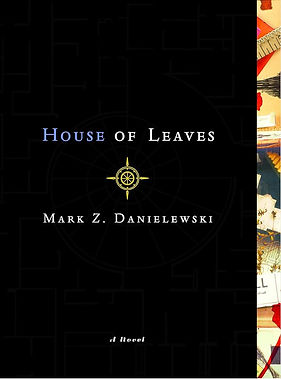
House of Leaves
Mark Z. Danielewski
"The walls are endlessly bare. Nothing hangs on them, nothing defines them. They are without texture. Even to the keenest eye or most sentient fingertip, they remain unreadable. You will never find a mark there. No trace survives. The walls obliterate everything. They are permanently absolved of all record. Oblique, forever obscured and unwritten. Behold the perfect pantheon of absence" (423).
You'd have to read it.
What is in your house?

How to Make Art at the End of the World
Natalie Loveless
"the crafting of a research question is the crafting of a story that is also the crafting of an ethics... rather than letting our research questions be conditioned by the structures of legibility and value given by, say, one's self-identifications as a painter.... tell stories differently and pair this with our own versions of the questions that Haraway asks herself: 'Whom and what do I touch when I touch my dog?' and 'How is becoming with a practice of becoming worldly?'" (24-25).
Through this manifesto, I continue to understand the debt owed to art history, feminism, critical race & Indigenous studies, research into gender & sex etc. in the old/new ways of study, inquiry, development of research-creation. How you learn, or are taught, or research, decides what you learn, or absorb, or create. All of the above is decided by systems, institutions, and conceived notions of what is acceptable. Loveless encourages mobilization in the arts as a conduit, a force, that can take part in reshaping the world - especially in the face of global warming.
Different elements of the world end each day; how do I choose what not to make art about?

In/Search Re/Search
Gabrielle Kennedy (ed.)
"Like all cognitive systems, law is based on facts and fictions... But it is not always clear how law relates to this 'reality'" (194).
This is one of the places I was introduced to Albrect's Solostalgia, homesickness for those who remain and watch the land change. I also added Anthropocene to my lexicon, the idea we are living in a distinct time that will be differed from others sometime in the future, where humans cause such an impact it can be found deep in our soil. Kennedy supports our questioning of what research is, how it can be pursued, and how it may be presented. I am biased, but questions that lead an artwork make it more exciting, human. Art and design fit in with other valid manners of pursuing knowledge, and now I wonder just how I can be a reliable narrator. It seems one must pursue unasked questions, unknown knowledge, and fitting art will emerge. I see people learning in a way that feels right to them, perhaps confusing to others, but a welcome show of the necessity of play. Curiosity is passion and love. I get emotional, it feels familiar, that painful want to understand.
My friend Anthony says that every joke has a kernel of truth, how do we get to that? I like to laugh, cry, and learn.
Let's Become Fungal!
Yasmine Ostendorf-Rodriguez
"By actively remembering, we can become aware of these entanglements, and their continued legacies on so many levels... not remembering, collective amnesia, is fertile ground for irresponsibility and repeating the missteps of history... I read about how in Greek language the opposite of a truth is not a lie, but forgetting" (59).
An intense crossover between consuming, researching, and depicting funga. Activism is like being funga. Funga reminds me of dendrites. The world is a knowledge keeper in herself.
I do not need to be above ground, how may I be a good mycelial root?
Making love with the land
Joshua Whitehead
"What does it mean to remove one's self wholly from stories; to write objectively as the inherent and sole truth-teller, as in non-fiction; or to delete pimatisowin from the autopsy of theorization" (92)?
Poetic, human, I cry. Whitehead traverses Indigenous and Non-Indigenous ideas about relations to land, storytelling, and identity. He is someone who notices unassuming, forgotten, or overlooked places, those many may be desensitized to or shy from.
I ask myself often, where do I speak from; from where do my dreams come; where am I from?


Metamorphosis
Franz Kafka
"He despaired of finding a way of imposing order and peace on all this mess. (21).
The family mourns for normalcy after their caretaker and son-cum-employee takes ill in an indescribable manner. He eventually dies, their hidden secret, and I guess they feel free. I would hope Gregor is freest in death, he mourned the most for his self.
It is not about a man turning into a bug, but still, I understand. If I manifested in another form, the world would move on. What matters?

Naked Lunch
William S. Burroughs
"'The Exterminator does a good job," said the Sailor. 'Almost too good, sometimes'" (170).
Brutally fascinating ugly language. Burroughs, an adept author who battled hard substances his whole life, beautifully describes the psychological, body, and eldritch horrors of addiction from behind an addict's eyes. I say with loving disgust: major trigger warning for most things you can think of and many you cannot. Still, its surreal style is foundational.
What does it really mean to be naked?


PESTS
Bethany Brookshire
"These animals have to move among people" (185).
I grew up in the North, in a suburb. I went to fenced-in schools, but still had lockdowns due to the occasional bobcat or bomb threat. I drive by golf courses in use only when the weather is well, and after they've been preened with god-knows-what chemicals. My dad says it is better now than when he grew up, but rarely do I see anything other than humans cross them. The tree farm near my house is uncanny, folks forget their colourful doggy bags, and note the time of the last bear sighting. The best spots by the lake are crowded by richly-furnished camps or industry, and some beaches soft-launch contamination warnings. I remember petting a goose with one misshapen leg on a decaying wharf. Seagulls swoop when you're walking downtown in the right season, squirrels beg for food outside coffee shops, crows tear through trash, a fox's back breaches the tall ditch grasses, and deer bring lyme to lawns. People twist up their expression, hit something on the road, set out traps. I think this book shows location is the determinant between an animal and a pest. The trouble is, this is a finite world that a few high on capitalism keep wanting to divvy up.
How we choose our words matters. How do we choose our words?

The Climate Book
Greta Thunberg
"There is, in reality, absolutely no reason to believe that the necessary changes will make us less happy or less satisfied... In no way should this be considered a step back in our development. On the contrary, this would be... human revolution" (241).
A fairly comprehensive survey of the development of the ongoing climate crises compiled through conversations and essays with numerous scientists and knowledge keepers worldwide. Everything is connected, you cannot be an environmentalist in a void. There are systems of ignorance and obfuscation that are hard to wade through. Reminds me of descriptions of Fahrenheit 451 (Ray Bradbury), censorships of the real muddled by being fed false ideologies. While we are lulled, inequality expands as the negative feedback loop balloons. Deaths are the start, continued BAU will affect all facets of health and wellness, economic disparity, racism, etc. For those that do not care, it is less costly for everyone to act now than later, and practical actions are not only demonstrated but suggestions for the individual are offered.
When will those in power finally act, or, be more selective about powerful inaction, ceasefires, and stoppages?


The Goat Or, Who Is Sylvia?
Edward Albee
"ROSS. (Long pause; shakes his head.) No. (Stevie is dragging a dead goat. The goat's throat is cut; the blood is down Stevie's clothes, on her arms. She stops) Oh, my God.
MARTIN. What have you done?!
STEVIE. Here" (53).
Spoiler.
What can you learn about yourself when you consume the antithesis of you?

The Mourner's Bestiary
Eiren Caffall
"There was a collapse in me, invisible to the naked eye as the losses of the ocean... What we are using to cope with the specter of collapse is more like anosognosia than denial. We expect the big things... will remain over time, regularity that can be transferred between generations. Even difficult things feel as if they will go on... Increasingly, we can't. Managing the emotional response to that fact remains a problem of scale... We do not know how to argue with anosognosia, with a flat refusal to look at reality, in ourselves or in others." (5; 145).
This book is about Caffall living with a genetic chronic illness, which she finds clarity with through the marine life she studies - both living, long-dead, and on their way out the door. It is at once candid as it is scientific and poetic. It reminds me of stories in National Geographic, species and stories inextricably entwined. I worry for the ones on their way out the door. There are things slipping through my fingers I cannot control, much like my chest-burning flare-ups. I was obsessed with animals as a kid, the rarer the better. There felt like something special in continuing to exist, but I realize these species had no other option. We have options in being able to perceive plurally, in parallels, and with a bigger picture.
Why should rarity be the measure of awe or respect when we can push any to its brink? What method of value could replace this?


The Sixth Extinction
Elizabeth Kolbert
"And if there were four extinct species, Curvier declared, there must be others... a daring [proposal] to make... Species died out. This was not an isolated but a widespread phenomenon. 'All these facts, consistent among themselves, and not opposed by any report, seem to me to prove the existence of a world previous to ours,' Curvier said. "But what was this primitive earth? And what revolution was able to wipe it out'" (30)?
The parallels of past extinction-level events with the current and projected climate conditions of today. The world has bounced back endlessly, but never the same way, and there is no guarantee humans will. Our reign is different than others', dividing and remixing geographic design. Still, we cannot be fatalist, it is privileged to give up hope. We must live for one another, for a better world for the most vulnerable.
We know what happens if we continue to do nothing. What can we save if we do something?

The Song of the Cell
Siddhartha Mukherjee
"As the naturalist Ignaz Dollinger would write in the 1800s, 'Life not is so much as becomes'" (138).
An introduction to how cells work, for better and worse. I thought it notable that every cell gives birth to daughter cells. Cells have all naturally selected to do something specific and respond in dozens, but not an infinite, number of ways. We are systems of systems.
I cannot help but think if all existent, living, on this earth and greater universe are but cells of a larger being. Who do we work for?

Ways of Seeing
John Berger
"All publicity works upon anxiety" (143).
Truly, several essays on perceiving traditionally Western imagery through a Western perspective. Topics include stretching conventions, inciting frictions, facing replications, and confronting the cacophony of visuals available daily. I found the chapter on nude bodies, specifically the objectification of women in its most literal sense, most pertinent.
How can action (life, an opposition to symbolism) be invited to a female body in art, nude or otherwise, when the ingrained perception is that "men act and women appear" (47)?

Women Who Run with the Wolves
Clarissa Pinkola Estes, Ph.D.
"The pattern is this: In all dying there is a uselessness that becomes useful as we pick our way through it all. What knowing we will come to reveals itself as we go along.'" (450).
Stories from around the world with the enlivening soul of a "wild woman." I have begun to breathe in cycles through this read. There is exhibition and exploration of dreamworlds, otherworlds, non-fictive fictions that show women in variety - messy, raw, disclosing their powers. I felt closest to Vasalisa, macabre stories from Eastern Europe. I do not have much understanding nor connection to my ancestry, but she came back to me.
As an ancestor severed from her traditional storytellers, long-scratched internally, how do I ensure my life is not simply performed?